

Card Dispute Guidelines
Guideline for handling card transaction disputes
1. What is a Dispute?
A dispute is a request or process to reverse a transaction and return the funds to the cardholder. Disputes are typically initiated when a cardholder:
- Did not receive the product or service.
- Does not recognize the charge or the business name on their statement.
- Believes the product is damaged, defective, or not as described.
- Was a victim of fraud, card theft, or identity theft.
A chargeback is the reversal of a transaction that takes place when the cardholder’s dispute is successful, offering protection against fraudulent or unauthorized merchant activity.
2. Best Practices for Resolving Disputes and Improving Win Rates
- Deactivate Lost or Stolen Cards Immediately – As soon as a card is reported lost or stolen, program partner must deactivate it to minimize the window for unauthorized transactions. Submit the dispute case promptly after the cardholder initiates the dispute.
- Collect Detailed Information – Program partner must work with the cardholder to gather comprehensive details about the incident and secure the cardholder’s attestation.
- Provide Strong Documentation – Program partner is to gather and submit thorough documentation, including merchant communications, receipts, and transaction timelines. Incomplete information or insufficient evidence can reduce the chances of winning the dispute.
- Contact the Merchant First – For collaboration disputes (disputes involving goods or services), program partner must request the cardholder reach out to the merchant directly. This can often lead to a refund, avoiding the need to escalate the dispute.
Proof of seeking collaboration between cardholder and merchant is required to initiate collaboration dispute. This can be email correspondence between cardholder and the merchant.
- No more than 15 fraud disputes can be initiated against the same card number.
3. Types of disputes
Disputes are categorized into four main types: FRAUD, AUTH, PROCESSING, and CONSUMER.
- Fraud – A fraud dispute is filed when a cardholder notices an unrecognized transaction on their statement. This may occur due to a lost or stolen card or a compromised PAN (Primary Account Number, also known as card number).
- Auth – Authorization disputes arise when a partner program seeks to recover funds spent by the cardholder, leading to a negative balance. This typically happens when a clearing transaction is processed without prior authorization. In such cases, the cardholder may have found a way to exceed their account balance without the program’s approval.
- Processing – Processing disputes occur when the transaction is valid but it contains incorrect data or metadata, such as an error in the transaction amount or account number.
- Consumer – A consumer dispute is filed when the cardholder has an issue with the merchant, such as receiving defective or incorrect merchandise, or not receiving the goods or services paid for. The cardholder requests a refund, but the merchant refuses.
Fraud and Auth disputes are also known as Allocation Disputes.
Processing and Consumer disputes are also known as Collaboration Disputes.
4. Things to check before raising dispute
Minimum Dispute Amount
Only transactions with an individual amount of USD 10 or more (or the equivalent in another currency) are eligible to be submitted as a formal dispute or chargeback through the card network process
Transactions below USD 10 will not be submitted as a formal dispute or chargeback.
Important: The minimum dispute amount applies only to dispute eligibility. Program partners must still report all transactions suspected or confirmed to be fraudulent to the Issuer, regardless of the transaction amount. This includes fraudulent transactions below USD 10 and unrecognised declined transactions.
Fraud
Unauthorised charge - card is still in cardholder’s possession
- The cardholder has checked and confirmed that no family members or
known persons have used the card without the cardholder’s knowledge/
authorisation.
Unauthorised charge - card is missing, lost or stolen
- Cardholder must immediately report the loss of card upon discovery and freeze it in the app or by contacting program partner.
- Cardholder will be liable for all transactions made prior to the reporting of the lost card.
Program partner is required to notify Issuer about any fraudulent transactions, even if they will not lead to chargeback/dispute.That includes unrecognised declined transactions.
Undisputed transactions – Fraud
The following transactions are not eligible for fraud dispute, as they are considered authenticated or authorised by the cardholder:
- Card-present transactions using:
- Contactless
- Chip and PIN
- Magnetic stripe
- Transactions made using provisioning tokens (e.g. Apple Pay, Google Pay), including:
- Contactless transactions
- Card-not-present transactions
- Card-not-present transactions that were successfully authenticated via 3D Secure (3DS)
Any transaction that has been authenticated using strong customer authentication (e.g. PIN or 3DS) is considered authorised and is not subject to the fraud dispute process.
- Fraud dispute examples
- ✅ Eligible dispute
Cardholder noticed on their bank statement a series of Card Not Present transactions, where none of them obtained successful 3DS authorisation. - ❌ Not eligible to dispute
Cardholder gave card details to their child who then purchased virtual currency in a video game. When requested 3DS authorisation, cardholder approved the transaction.
- ✅ Eligible dispute
Processing
Recurring charges/subscription fees that have been cancelled
- Cardholder to confirm cancellation was done as per merchant’s policy.
- Cardholder must have made attempt(s) to resolve the dispute with the merchant directly prior to the submission of this form.
- Cardholder must provide:
- Proof of cancellation made to the merchant, and
- Proof of dispute raised with the merchant.
Refund/credit not processed
- Request for refund has been made as per merchant refund/cancellation policy, but credit/refund was not received.
- Attempt(s) has/have been made to resolve with the merchant directly but failed.
- Cardholder must provide:
- Proof of refund by the merchant on the goods/merchandise.
- Proof of dispute raised with the merchant (example: email correspondence).
Transaction amount or currency differs from the original billing
- Transaction amount or currency differs from the original billed/invoiced amount from the merchant.
- Exchange rate differences and applicable fees and charges levied by the bank or merchant, causing a difference to the billed amount, do not qualify for a dispute.
- Cardholder must provide:
- Proof of transaction amount; or
- Proof of currency of billing.
Duplicate billing/transaction paid by other mode
- Duplicate billing: Merchant billed twice or more for the same goods/merchandise.
- Paid by other mode: Transaction using a Standard Chartered card failed,
leading to the goods/merchandise being paid for by cash or the cardholder’s
other card. - All recurring/installment/giro billings do not qualify for a dispute.
- Cardholder must provide:
- Proof of original sales invoice (if available)
- Proof of paying by other mode (example: cash/ charge slip of using another card)
Undisputed transactions – Processing
Transactions are not eligible for processing dispute where:
- Charges are applied in accordance with the merchant’s stated terms and conditions; or
- Subscription cancellations only take effect in a subsequent billing cycle, as clearly stated by the merchant.
- Processing dispute examples
- ✅ Eligible dispute
Cardholder authorised payment of USD 10, however received a charge of USD 100. - ❌ Not eligible dispute
Cardholder cancelled subscription however still received charge for the ongoing month. In merchants terms and conditions, it is stated that the cancellation of subscription triggers only in the following calendar month.
- ✅ Eligible dispute
Consumer
Goods/merchandise received is defective, or is not as described
- Cardholder must have returned or attempted to return the goods/merchandise directly to the merchant, to obtain a refund and failed
- Please liaise directly with the merchant for disputes regarding quality of service. The issuer is unable to assist in any disputes regarding quality of service of a merchant.
- Cardholder must provide:
- Proof of cancellation made to the merchant.
- Proof of dispute raised with the merchant (example: email correspondence)
Goods/merchandise not received
- Cardholder must have attempted to resolve the matter with the merchant directly to obtain a refund and failed.
- Cardholder must provide:
- Proof of invoice with expected date of goods / merchandise delivery.
- Proof of dispute raised with the merchant (example: email correspondence)
Undisputed transactions – Consumer
Transactions are not eligible for consumer dispute where:
- The merchant’s terms and conditions clearly state that the sale is final and non-refundable; or
- The cardholder’s dissatisfaction is based on personal preference (e.g. colour, design) rather than non-delivery or misrepresentation.
- Consumer dispute examples
- ✅ Eligible dispute
Cardholder bought shoes online however received different size than indicated on the receipt. The merchant is not contactable and therefore is not able to accommodate request for an exchange. - ❌ Not eligible dispute
Cardholder bought shoes online. On the product site, it is indicated that the purchase is final and is not subject to returns or exchanges. Upon receipt, cardholder doesn’t like the colour of the shoes and wishes to return them. Merchant doesn’t want to accommodate return request referring to their sale terms and conditions.
- ✅ Eligible dispute
5. Dispute process
Every dispute requires collaboration between cardholder, program partner and issuer.
Program partner is required to do the initial assessment of cardholder claims and, if deemed to be valid, collect information and evidence from the cardholder.
Where an unauthorised transaction has been reported, program partner is required to ensure that the card is blocked and, if transaction is deemed fraudulent, the card is reissued.
Transaction dispute process follows linear flow.
Program partner:
- Presentment - transaction clearing event. In order for it to be a dispute, the transaction must clear first.
- Prepare case - program partner assembles the necessary information obtained from the cardholder to prepare the dispute at the network.
- Create case - program partner creates a dispute case on behalf of the cardholder.
- Submit to issuer - program partner submits the case, together with all the evidence, to the issuer.
Issuer:
- Review - issuer reviews provided by the program partner information and evidence.
- Decision - issuer decides whether the reported transaction falls under network dispute program and can be submitted a formal dispute with the merchant.
- Submit to network - issuer files a case against a merchant.
- Network dispute initiated - the dispute enters the network dispute lifecycle. The acquiring bank can respond to the dispute directly or forward it to the merchant. The acquirer/merchant can accept the loss or provide documentation to refute the dispute claim.
- Representment (second presentment) - the acquiring bank attempts to refute the claim by submitting compelling evidence, e.g. signed copy of a receipt.
- Prearbitration - last stage before arbitration where issuer/acquirer can decide to accept the other side’s claim or evidence.
- The issuer will inform program partner about the dispute entering this stage.
- Program partner will decide whether to accept the other’s side evidence or submit new evidence that will potentially enter arbitration stage.
- The program partner to work with the cardholder to gather new evidence.
- Arbitration - all information and supporting data has been provided to the network and the network makes the final decision. The decision must be accepted by both issuer and acquirer. Any dispute entering this stage is subject to network fees.
- Resolution - the dispute is resolved and closed.
- If dispute is won, the program partner will be notified about the outcome and the funds will be deducted from the partner’s settlement balance. The program partner has to allocate the refunded funds to the cardholder account.
- Program partner is advised to inform the cardholder about the outcome.
Important information and supporting evidence required for each dispute reason
| Dispute Scenario | Information Required | Required Supporting Documents and Information |
|---|---|---|
| Suspected transaction subject to fraud / unauthorized / not recognized transactions | • Chronology of the case • Details of the disputed transaction(s) | • Not mandatory; users may provide additional details where available |
| Service paid but not received | • Description of the service purchased • Expected service delivery date | • Proof of Payment (invoice, payment receipt, etc.) • Proof of communication with the merchant (WhatsApp, email, etc.) |
| Goods paid but not delivered | • Description of the goods purchased • Expected delivery date | • Proof of Payment (invoice, payment receipt, etc.) • Proof of communication with the merchant (WhatsApp, email, etc.) |
| Recurring payment cancelled but still billed | • Description of the subscription • Details of charges after cancellation | • Proof of cancellation • Proof of payment • Proof of communication with the merchant (if applicable) |
| Service cancelled but still billed | • Description of the service / subscription purchased • Details of charges billed after cancellation | • Proof of payment (invoice, payment receipt, etc.) • Proof of cancellation confirmation • Proof of communication with the merchant (WhatsApp, email, etc.) |
| Goods received but not as described / counterfeit | • Description of the goods purchased • Chronology of the case, including the merchant’s explanation (if any) | • Proof of payment (invoice, payment receipt, etc.) • Proof of return (if goods were returned), e.g. delivery note with tracking number • Listing evidence and photos (if the goods is fake/ empty) • Proof of communication with the merchant (WhatsApp, email, etc.) |
| Service received but not as described | • Description of the service purchased • Chronology of the case, including the merchant’s explanation (if any) | • Proof of payment (invoice, payment receipt, etc.) • Listing evidence and service agreement / description • Proof of communication with the merchant (WhatsApp, email, etc.) |
| Refund not received despite merchant agreeing to refund | • Description of the goods or service purchased • Chronology of the case, including confirmation that the merchant agreed to refund | • Proof of payment (invoice, payment receipt, etc.) • Proof of refund agreement and communication with the merchant • Proof that refund has not been received (bank or card statement) |
6. Dispute process timeframes
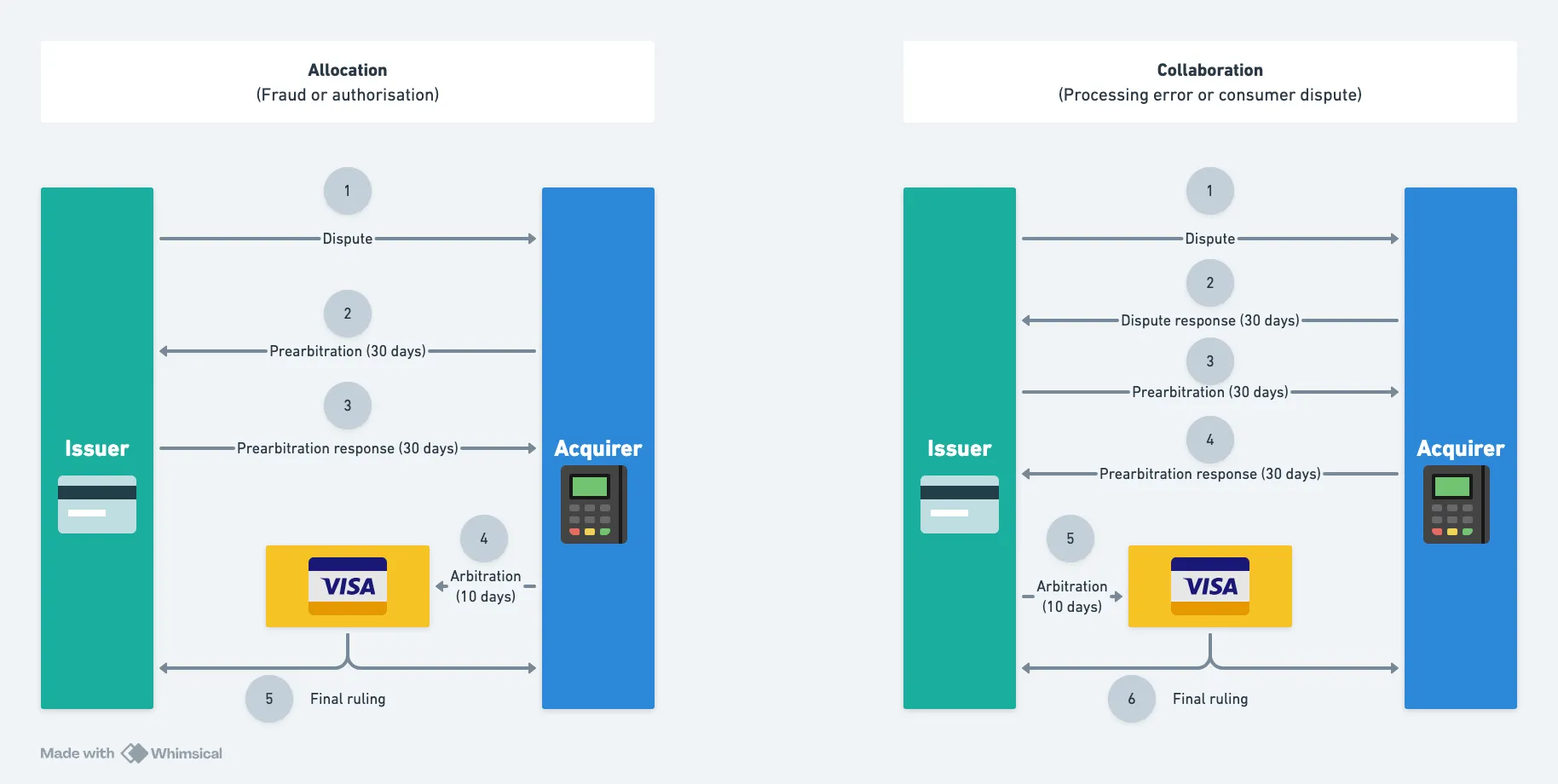
Dispute - issuer is able to only accept disputes within:
-
Allocation:
a. Fraud Dispute : 120 days from the date of the disputed transaction.
b. Authorization Dispute : 75 days from the date of the disputed transactions -
Collaboration:
c. Processing Dispute : 75 days from the date of the disputed transactions
d. Consumer Dispute : 60 days from the date of the disputed transaction.
Fraud and Authorization Disputes (Allocation):
- Prearbitration: 30 days
- Prearbitration response: 30 days
- Arbitration response: 10 days
Processing Errors and Consumer Disputes (Collaboration):
- Dispute response: 30 days
- Prearbitration: 30 days
- Prearbitration response: 30 days
- Arbitration response: 10 days
7. Fees
Visa arbitration fee
During the arbitration case filing stage, the Visa chargeback committee reviews the case and issues a ruling. They evaluate both the cardholder's claim and submitted documentation against Visa regulations. The party that fails to meet dispute conditions and requirements loses the chargeback and must pay a USD 600 filing fee per transaction in addition to the disputed amount.
8. Reporting fraud
The Card network requires all issuers and programs to report fraud cases to the card network, regardless of transaction amount whether the cardholder wishes to raise a dispute. A fraud report must be submitted to the card network for every instance of cardholder-reported fraud. Failure to comply with these card network rules can result in fines and the suspension of the ability to process chargebacks.
This reporting obligation also applies to transactions below the USD 10 minimum dispute amount. Although such transactions will not be submitted as formal disputes, they must still be reported for fraud monitoring and card-network reporting purposes.
9. Contact details
For further enquiries or questions related to disputes, program partner can contact the disputes team using the following contact details:
- Card Disputes [email protected]
Updated 3 months ago